Hugh Mannshield’s Bio
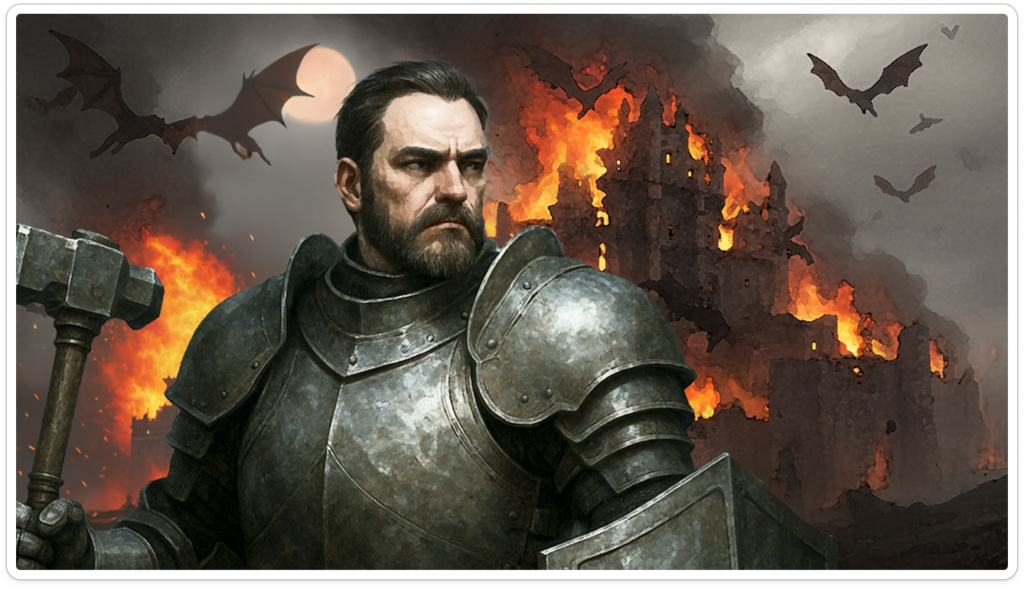
A scarred man in dented plate, eyes ringed by sleepless nights. His hammer bears a single engraving: “Hold the line.” A faint light sometimes flickers in the runes along his armor—not radiant, but cold and mournful, like moonlight on a grave.
Once a knight of Lastwall, Hugh dedicated his life to shielding others from the undead horrors that plagued the borderlands. When the Whispering Tyrant’s armies swept across Gallowspire, Hugh’s garrison held their post to the last, until the light failed. Buried beneath rubble and corpses, he survived by what he thought was divine intervention. In truth, something watched him in that darkness, and when he awoke, he was no longer certain whether it had blessed him or cursed him.
Years later, Hugh was found wandering near Lepidstadt, haunted and hollow-eyed but still carrying his shield. The Limina Foundation recruited him for his experience facing supernatural threats and his uncanny instinct for sensing when “something wrong” lingers unseen. Though he rarely speaks of it, Hugh sometimes murmurs prayers to no god anyone recognizes, words that taste like ash and light both.
Hugh is steadfast and self-sacrificing, but his faith is fractured. He no longer fights for glory or divine favor, only for those who can’t defend themselves. When others see hopelessness, he sees one last stand.
He fights the way Lastwall taught him: warhammer in hand, shield braced, body between the threat and anyone who cannot take the blow themselves. There is nothing elegant about it. Hugh does not duel. He does not finesse. He plants his feet and he holds the line, and when the line breaks he holds it anyway, because that is what guardians do and the dead taught him what happens when someone decides it isn’t worth holding anymore.
The streets of Lepidstadt taught him something else. During an encounter with children possessed by black sand, hollow-eyed and speaking with a voice that wasn’t theirs, Hugh did what a soldier does when the innocent have already been taken and turned into weapons. He struck them down. He would do it again. He knows this. The knowing sits in his chest like a stone he cannot swallow and cannot spit out, and it is heavier than his shield has ever been.
It was after that night that Mira found him.
She is nine years old. She is dead. She is a street urchin named Mira who was among the possessed children, who had a six-year-old brother named Tomis, who was invisible her entire short life and is now invisible in a different and more permanent way, except to Hugh. She appeared first as a flicker at the edge of his vision, a shape in the mirror that vanished when he turned his head, a cold spot in a warm room that followed him from corridor to corridor. Then she spoke.
“You can see me. I thought so. Nobody else does.”
She has not left since.
Hugh carries her the way he carries everything: without complaint, without understanding, without certainty about whether this is penance or grace. His breath mists on warm days now. Frost traces the edges of surfaces where his hands rest too long. He sleeps badly, when he sleeps at all, because Mira’s dreams bleed into his and her dreams are full of cold streets and hunger and a brother she cannot find. She is not malevolent. She is lonely, and frightened, and dead, and she chose the one person who saw her because nobody else in her life or her death ever bothered to look.
She sees things Hugh cannot. Spirits in the corners of rooms. The shape of death settling over the shoulders of those marked for it. The wrongness that clings to places where the veil has thinned. She whispers warnings in his ear, tugs at his awareness when something dead is watching from behind. She saved his life once already, throwing herself between him and a killing blow with a force that should not be possible for a thing made of grief and cold air.
In return, Hugh has promised her two things. He will find out what happened to Tomis. And he will not forget her.
He believes the Foundation’s investigation into Lake Prophyria will lead him to the source of his “blessing.” He fears that what saved him in Lastwall was not divine mercy but the same hunger that now moves within the mists. He fears, more quietly, that whatever watched him beneath the rubble at Gallowspire and whatever allows him to see Mira now are the same thing, and that the price for both has not yet been named.
But Hugh has never been a man who lets fear choose his direction. He walks toward the thing that frightens him, shield up, hammer ready, a dead girl’s cold hand resting on his shoulder. The last knight of a fallen fortress, still holding the line. Still standing between the darkness and anyone too small or too broken or too dead to stand for themselves.
That is what guardians do.
© 2018 – 2026 Darren F. Gideon and Contributing Players. All rights reserved. | Legal & Licenses