Jorato Starjoe’s Bio
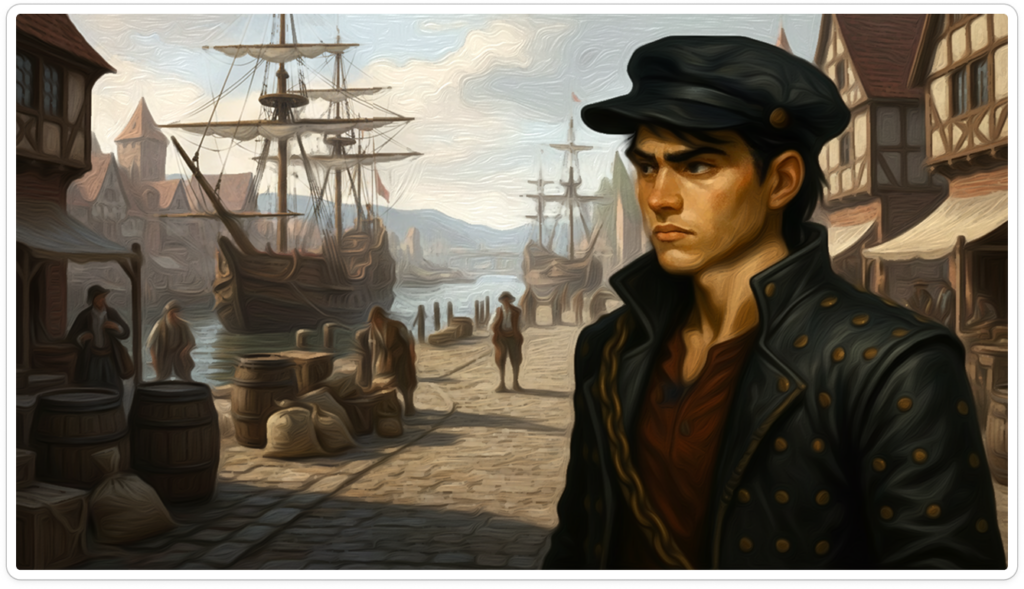
Jorato Starjoe grew up in Lepidstadt’s industrial quarter, the son of a schoolteacher and a father, Jonas Starjoe, who vanished on a “security contract” years ago. Only later would he learn that his father had been a field operative for the Esoteric Order of the Palatine Eye, and that the family line carried a dormant psychic trait called Ancestral Resonance.
For most of his life, Jorato was just a strong, angry kid. Then came the night in the canal-side alley.
A fight with a group of thieves. A crate splitting open. Black sand spilling out like smoke. The world began to warp, the air thickened, the walls folded inward, and one of the thieves screamed as his body started to unmake itself. Jorato doesn’t remember what happened next. When he came to, the alley was still, the thieves were gone, and the air smelled of metal and ozone. Terrified, he walked to the nearest watch post and turned himself in, saying there was “something inside him” and he needed to be locked away.
The constables who took his statement thought he was raving. Their report described a collapsed structure, black particulate residue, and possible hallucinogen exposure. They filed it as an unsolved homicide. Weeks later, the case reached a regional investigator with quiet ties to the Limina Foundation, who recognized the phrase “black sand” and flagged it for review.
Jorato carries guilt like a second skin. Three men died in that alley. The constable’s report says “unsolved homicide.” Jorato knows the truth. He also knows that the thing inside him, the force that tore through brick and flesh and left cobblestones fractured in a three-meter radius, is still there. Still capable. Still waiting for the next time the world pushes hard enough to break the surface.
When the Foundation arrived, they found Jorato still in jail. Silent. Cooperative. Convinced that what he carried was a curse. They offered him a different kind of confinement: training. Under their supervision, he would learn to understand the thing they called Shining Fist, and in return, help them study and defend the boundaries of existence itself.
He agreed, not because he trusted them, but because he couldn’t trust himself.
Shining Fist is the eidolon. It manifested in fire and violence on the worst night of Jorato’s life, and it has not left since. It is bonded to him through an empathic link that goes deeper than speech, deeper than thought, down into the place where identity meets instinct. What Shining Fist touches, Jorato feels. What Shining Fist perceives bleeds through into Jorato’s dreams. The eidolon does not process the world the way Jorato does. It is curious where he is cautious, direct where he is guarded, alien where he is painfully human. It protects him with absolute loyalty and no particular understanding of why loyalty should require explanation.
But Jorato is not only what happened to him in an alley.
He is also, and perhaps more fundamentally, the boy who grew up in a house full of stories.
His Nanna was a woman who had a tale for everything. Not fairy stories in the soft, comforting sense, but the real ones, the old ones, the kind that end with someone drowned or changed or taken and a warning delivered too late to matter. She told them at the kitchen table while kneading bread, or in the garden while pulling weeds, or at the bedside when thunder rolled and the lamps guttered. Her stories were about river spirits who collect names like pearls. About spiral stones that trap what the current wants to steal. About fey tokens that reform no matter how many times you break them. About castles where you count the bells on the new moon and pray the number stops at twelve.
Her cousins and uncles were the same. The Starjoe family carried its history in spoken word, passed down through kitchen conversations and late-night warnings and offhand remarks that turned out, years later, to be the only useful intelligence anyone had about the thing standing in front of you with too many teeth.
Nanna never speaks to Jorato in real time. She is not a ghost in his head, not a voice whispering guidance when the moment demands it. She is memory. She is the story he didn’t understand when he was eight that suddenly makes perfect sense now that he’s staring at a spiral of white stones on a riverbed and needs to know whether someone is protecting what they love or keeping something dangerous locked away. She is the cousin’s tale about a man who died of winter fever in his sleep and made breakfast the next morning, not knowing he was dead, and the terrible relevance of that story when you are watching black-veined villagers smile their practiced smiles and offer you a tonic that will make everything quiet.
This is how Jorato navigates the world that has opened up beneath his feet. Not through arcane study. Not through divine revelation. Through his Nanna’s stories and his uncle’s warnings and the accumulated folk wisdom of a family that lived in Ustalav long enough to know that the old wives’ tales are not tales at all.
The Limina Foundation gave him a mission: travel the Mourntray River aboard the Cestus, investigate what happened to the teams that went silent, find out what waits on Lake Prophyria. He accepted because the alternative was a jail cell and the growing certainty that Shining Fist would eventually break free whether he cooperated or not.
He did not expect to need Nanna’s stories so badly. He did not expect the river to be full of the things she warned him about. He did not expect to find himself standing at crossroads where the veil is thin, handling fetch dolls woven from river rushes and black feathers, watching the fey courts circle each other with the patient hunger of wolves deciding which lamb to take first.
He did not expect to feel, with growing and terrible clarity, that his father’s disappearance, his family’s stories, the black sand in the alley, and the thing bonded to his soul are all connected. That Jonas Starjoe did not vanish on a security contract. That the Ancestral Resonance running through the family blood is not dormant at all, but has been listening, and remembering, and waiting for someone in the line to finally stand close enough to a convergence point for it to wake up.
Jorato is young. He is carrying three deaths, an eidolon he did not ask for, and a family inheritance he is only beginning to understand. He fights because the alternative is standing still while the world collapses around him, and Nanna’s stories always made it clear what happens to people who stand still when the river rises.
“The river has hunger,” Nanna said. “Not for your body. For you. For what makes you you.”
Jorato intends to keep what makes him him. Shining Fist intends to help, in its own alien, loyal, not-quite-human way. And Nanna’s stories, told in a kitchen that smelled of bread and herbs and the honest weight of a woman who had survived Ustalav by knowing which warnings to take seriously, will keep arriving exactly when they are needed most.
Not because she is speaking to him. Because he finally learned to listen.
© 2018 – 2026 Darren F. Gideon and Contributing Players. All rights reserved. | Legal & Licenses